

CPR in the workplace: what changes for businesses from 2026
In brief
Since 1 January 2026, CPR training for employees has been a legal obligation for every employer in Greece (Law 5239/2025). What is required at each site, the roles of the safety technician and the occupational physician, the steps to compliance and the link with ISO 45001.
As of 1 January 2026, training employees in cardiopulmonary resuscitation is no longer optional — it is a legal obligation. Law 5239/2025 introduced specific requirements that apply to every employer in Greece, regardless of sector or business size.
What CPR is — and why it matters in an industrial setting
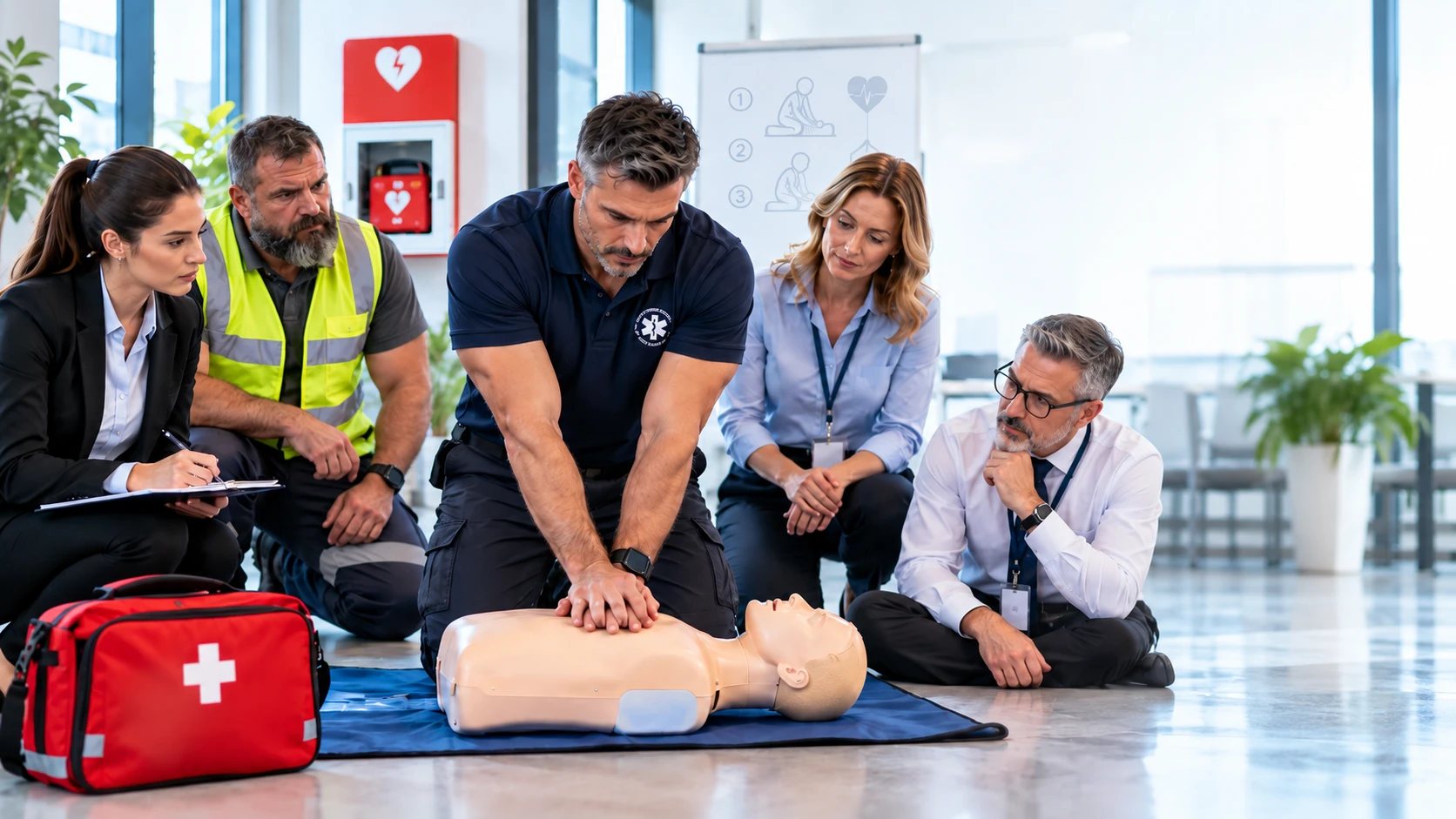
CPR (cardiopulmonary resuscitation) is the immediate intervention given to a person in cardiac arrest, to keep the blood circulating until an ambulance arrives. Combined with an automated external defibrillator (AED), CPR given in the minutes after a cardiac arrest can make the difference between survival and death.
This is not only about hospitals or high-risk settings. It concerns offices, warehouses, construction sites and industrial plants — anywhere people work.
What exactly Law 5239/2025 requires
Article 39 of Law 5239/2025 requires employers to ensure that training is provided in CPR and in the Heimlich manoeuvre (for airway obstruction). The requirements are not uniform — they depend on the number of employees per site:
- Up to 50 employees per site: use of the free training material provided by the Ministry of Labour.
- More than 50 employees per site: training of at least 50% of employees by certified providers, at least every 3 years.
An important clarification: the legislation does not impose a general obligation to install a defibrillator in every business. Whether a defibrillator is needed depends on the risk assessment and the particular conditions of each workplace.
The roles of the safety technician and the occupational physician
This is a frequent source of confusion, so it is worth clarifying.
The safety technician (Articles 504–505, Presidential Decree 62/2025) has an advisory and supervisory role: they take part in planning training programmes, advise on first-aid equipment and organise the response to emergencies.
The occupational physician (Articles 507–508, Presidential Decree 62/2025) contributes from a medical standpoint: they determine the training needs, give instructions for emergencies and, when present, provide immediate care in the event of an accident or sudden illness.
The two work together under Article 510 of Presidential Decree 62/2025 — but responsibility for implementation rests solely with the employer. Employing a safety technician or an occupational physician does not replace the obligation to have training delivered by a certified provider, where that is required.
Steps to compliance — without unnecessary complexity
The practical approach is fairly simple:
- Headcount: How many employees work at each site? This determines which route you follow.
- Training: For small sites, the Ministry of Labour's material is already available. For larger ones, training with a certified provider needs to be scheduled in good time — the three-year cycle means it has to be tracked systematically.
- Documentation: Attendance sheets, training certificates, details of the training provider. In an inspection, these are what count.
- Readiness review: Who the trained employees are, where the first-aid equipment is kept, and when refresher training is due.
Link with ISO 45001:2018
For businesses that maintain an ISO 45001 system, or are considering one, CPR training fits naturally into two core requirements of the standard: competence (clause 7.2) and emergency preparedness and response (clause 8.2).
Integrating it into the OH&S management system allows it to be monitored systematically — and demonstrates a genuine, not merely formal, commitment to safety.
How Certway can help
Certway helps businesses map their legal obligations, organise and document their training programmes, and integrate them into ISO 45001 management systems.
Compliance with Law 5239/2025 is not a bureaucratic exercise. It is organised preparation for a situation that no one wants to face unprepared.
Contact Certway to assess your business's needs.
Sources
- Law 5239/2025, Article 39
- Presidential Decree 62/2025, Articles 504, 505, 507, 508, 510
- Ministry of Labour – first-aid training material
- ISO 45001:2018